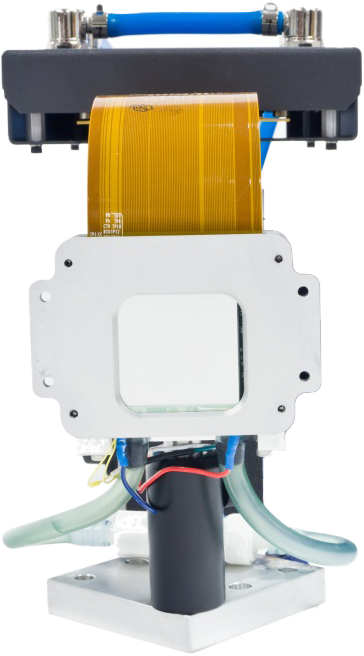
High resolution High speed High Phase Stability Pure analog phase control High...
Details
A spatial light modulator (SLM) dynamically manipulates optical wavefronts by controlling the amplitude, phase, or polarization of light. These devices serve as programmable masks that alter light patterns across two dimensions, enabling precise, application-specific modulation. SLMs find use in optical processing, data routing, beam shaping, and information display, among other applications. They operate using different methods and materials, with liquid crystals (LCs) being a common choice due to their high birefringence and low-voltage operation. This allows for significant optical effects in thin layers, making LC-based SLMs highly efficient.
SLMs are typically available in two main operating modes: transmissive and reflective. The choice between these depends on factors such as the wavelength range, optical architecture, and performance requirements. Transmissive SLMs consist of a nematic liquid crystal layer sandwiched between transparent conductive windows, where individual pixels are electrically controlled to modulate light passing through. Reflective SLMs, often built on liquid crystal on silicon (LCOS) technology, feature a reflective coating—such as aluminum or dielectric coatings—that enhances diffraction efficiency and image quality by reflecting the modulated light.
At the core of an SLM’s function is a liquid crystal layer whose refractive index can be electrically tuned by applying voltages across pixels arranged in a periodic structure with a defined pixel pitch. This modulation induces a phase delay or phase shift in the reflected or transmitted light, allowing fine control over the phase response of the light waves. Key specifications such as fill factor, the ratio of active pixel area to total pixel pitch, and spatial resolution critically influence device performance. The ability of liquid crystal SLMs to provide continuous phase levels enables complex field modulation and the creation of computer-generated holograms, which are essential for advanced applications like holographic beam shaping and single-channel digital holography, as explained in detail in spatial light modulation principles.
These capabilities make SLMs indispensable tools for R&D laboratories, universities, optical engineers, and manufacturers across aerospace, defense, microscopy, semiconductor, medical devices, and telecommunications sectors. They facilitate high-speed, high-resolution optical processing and custom beam control spanning visible to infrared wavelengths, aligning with Meadowlark Optics’ broader polarization solutions and components portfolio. Meadowlark Optics specializes in liquid crystal on silicon (LCOS) spatial light modulators that combine exceptional speed, efficiency, and resolution to deliver accurate and reliable optical modulation.
The versatility of SLMs extends to numerous fields, including adaptive optics, volumetric imaging, optogenetics, and holographic tweezing research, as well as optical communication systems, STED microscopy for super-resolution imaging, and femtosecond pulse compression. Their ability to simultaneously modulate amplitude and phase enables sophisticated light-field manipulation, which is crucial in optical trapping experiments and laser beam shaping. Optimizing diffraction efficiency by designing blazed gratings and the grating pitch within the SLM’s periodic structure further enhances brightness and intensity control.
Meadowlark Optics offers a broad range of high-performance spatial light modulators characterized by exceptional phase stability, fast frame rates, and high diffraction efficiency. These devices support applications spanning UV to MWIR wavelengths and provide tailored solutions for researchers and OEMs who require precise optical modulation with minimal phase ripple and superior spatial resolution, which are compared in detail in our spatial light modulator selection guide.
High resolution High speed High Phase Stability Pure analog phase control High...
DetailsHigh Power Handling Water Cooled TEC active heat dissipation Heat-conducting sapphire coverglass...
DetailsFast hologram-to-hologram operation Thermally controlled High resolution High speed High phase stability...
DetailsEntry-Level 1920 x 1200 Resolution Pure Analog Phase Control High Phase Stability...
DetailsReady to use for easy setup. Scan-less SLM-based Fully functional programmable excitation...
DetailsComplete Optical Tweezing Kit using high-resolution 1920 x 1200 SLM Custom software...
DetailsReady to use for easy setup. Includes: Polarizers and waveplates Beam expander...
DetailsWe use cookies to improve your experience on our site. By using our site, you consent to cookies.
Manage your cookie preferences below:
Essential cookies enable basic functions and are necessary for the proper function of the website.
These cookies are needed for adding comments on this website.
Google Tag Manager simplifies the management of marketing tags on your website without code changes.
Statistics cookies collect information anonymously. This information helps us understand how visitors use our website.
Google Analytics is a powerful tool that tracks and analyzes website traffic for informed marketing decisions.
Service URL: policies.google.com (opens in a new window)
SourceBuster is used by WooCommerce for order attribution based on user source.
Marketing cookies are used to follow visitors to and from 3rd party websites. The intention is to show ads that are relevant and engaging to the individual user.
Pinterest Tag is a web analytics service that tracks and reports website traffic.
Service URL: policy.pinterest.com (opens in a new window)